
Checking for a Warrant in Indiana
Indiana offers no single public search for every active arrest warrant. That gap surprises people. The Judicial Branch warrant FAQ puts it plainly: MyCase is a case search, not a warrant search. An eligible case summary may show a warrant event. But the portal cannot establish current service status across all courts. The issuing court keeps the case record. Its clerk confirms the docket. The Indiana sheriff, or another service agency, confirms its own current warrant record. Those are two separate answers. For your own case or a family member's, follow the paperwork to the Indiana court and ask each office what it can answer. Keep the citation, case number, court notice, and hearing date handy.
- There is no public interface for querying IDACS or NCIC. Use MyCase to look for an eligible public court case by party, case number, citation number, or attorney, then treat a result as a lead to the docket rather than proof of a live warrant.
- Check the citation, summons, or notice for the issuing court. A city or town court may keep a separate docket, so do not assume a county-court result covers it.
- Call the county Clerk of the Circuit Court or the city/town clerk about the official docket, orders, and how to request a copy. A narrow records request goes to the office that holds the record; Indiana Judicial Branch records held by OJA have a separate request route.
- Check whether the county sheriff provides a public warrant page, then ask its warrant division or service agency whether its current record shows an active, served, recalled, or reissued warrant. Ask about the court-approved next step; a list may not be complete or current.
- If a traffic case shows a BMV suspension, check that driving status separately with the BMV and the issuing court. A suspension is not itself proof of a criminal arrest warrant.
- For a possible warrant in another county, use the Indiana county directory to reach that court and sheriff. Federal matters use a separate federal court and U.S. Marshals route.
Why Indiana Has No Public Warrant Search
Warrant information in Indiana lives in several separate systems. No public portal inventories all active arrest warrants. MyCase is a public case search for participating Odyssey courts in Indiana. An eligible public case may show a warrant docket event. Participation dates, case type, and access rules shape what appears. That is not a live all-county warrant roster. The statewide side works differently. The Indiana Data and Communications System (IDACS) links authorized criminal-justice users to state and national systems, including NCIC. Its records stay closed to public self-service. Counties and local courts keep case and service details where the order was issued or received. Other state records answer different questions: a BMV record concerns driving privileges, while INcite e-Tax and the Department of Revenue handle civil tax warrants. Neither tells you whether an Indiana arrest warrant is active.
| Record Route | May Help With | Cannot Establish |
|---|---|---|
| MyCase / Odyssey | Eligible public case details and docket events | Every active warrant or current service status |
| IDACS / NCIC | Authorized criminal-justice wanted-record access | Public access or a complete online county list |
| Issuing court and sheriff | Official docket and local service confirmation | One uniform process used by every county |
| BMV | Driver-privilege suspension or reinstatement status | Criminal warrant status |
| INcite e-Tax / DOR | Civil tax-warrant records and collection | Arrest, bench, or traffic-warrant status |
Note: A blank case search or county-list entry does not establish that an Indiana court has no active warrant.
Inside the Indiana Statewide Warrant System
No public Indiana statewide arrest-warrant database exists to search. The statewide criminal-justice backbone is IDACS. It is administered within the Indiana State Police Criminal Justice Information Services Section. IDACS connects authorized users to justice information. That includes national NCIC records. But it is not a public person-search product. Indiana State Police publishes no all-state warrant roster either. Warrants start with a court order, and the court's clerk maintains the case-side record. The sheriff or another agency receives the process and tracks service or status in its own system. That originating agency is responsible for confirming whether a wanted record remains valid. The chain is deliberately decentralized. So anyone wanting a current answer in Indiana must identify both the issuing court and the service agency. A local entry may not be publicly searchable at all. It also may not sync in any way a reader can inspect. For the roles of Indiana State Police, IDACS/NCIC, and the federal layer, see the Indiana warrant system overview. It shows how a county order relates to authorized statewide and national law-enforcement databases, without pretending the public can query them directly.
Indiana MyCase Events Are Not Warrant Status
Indiana MyCase can help you find the case behind a warrant question. It is a case-search system, nothing more. Search fields can locate a case or a party. They cannot prove every warrant has been found. Nor can they show whether an agency has served, recalled, or re-entered one. Available controls and case data also vary with the Indiana court and case type. The search guidance describes three paths. A case-number search takes a case, citation, or cross-reference number. Party search starts with a last name or business name, then narrows with an optional first name, middle name, date of birth, court, filing dates, or case status. Attorney lookup uses a bar number or name. MyCase searches may return up to 1,000 results, and a CAPTCHA can appear after repeated searches.
| Search Path | Useful Identifiers | Limits to Remember |
|---|---|---|
| Case | Case, citation, or cross-reference number | Old and current number formats may differ |
| Party | Last name or business name; optional first, middle, DOB | DOB may be absent; name matches can include other people |
| Attorney | Bar number or attorney name | Finds cases associated with counsel, not a person’s warrants |
| Filters | Court, case type/status, filing-date range | Available options depend on the live database and court |
Check spelling and paperwork identifiers when a search returns no case. A trailing asterisk matches the start of a name. It cannot replace a whole first or last name, and sound-like matching cannot be combined with a wildcard. Once a useful case appears, contact the Indiana clerk and sheriff for confirmation rather than treating the result as final status. Note: MyCase results are leads to eligible case records, not an Indiana statewide clearance check.
Indiana Warrant Types
Indiana warrant labels follow the case and the order. An arrest warrant lets an officer bring a person before the issuing court. A bench warrant is court-issued process. It often follows a missed hearing or a failure to comply. State law sets particular grounds and contents for arrest warrants. The order and docket control what applies to an individual Indiana case.
| Warrant or Process | How It Arises | Issuing Authority |
|---|---|---|
| Arrest warrant | Judicial probable-cause process in a criminal matter or another statutory basis | Judge or court under Indiana law |
| Bench warrant | Missed required appearance or another court-directed event | Judge of the court handling the case |
| FTA-related process | A missed date may lead to a bench warrant or another court action, depending on the case | Issuing court; FTA is a reason, not a separate statewide warrant class |
| Search warrant | Order authorizing a search of specified places or items | Judge; not an arrest order |
| Body attachment | Civil process to bring a person before court where authorized | Court in the civil proceeding |
| Fugitive or supervision warrant | Out-of-state process or alleged violation of supervision | Issuing court or responsible corrections authority |
| Tax warrant | Civil tax collection instrument filed through statutory process | Tax authority and clerk process; not arrest process |
Docket shorthand can trip people up. "FTA" just means failure to appear; it describes a missed court date, not a statewide portal or a charge of its own. Indiana dockets do not use one uniform label for failure to appear or pay, and "capias pro fine" should not be assumed as the standard term. A tax warrant is civil. A body attachment is a civil-arrest order. Neither one is a criminal arrest warrant, so ask the issuing court what the local docket term actually means in your Indiana case.
Which Indiana Courts Issue Warrants
Indiana handles its trial courts county by county, and the setup varies. Circuit and Superior Courts are the general-jurisdiction courts that issue most Indiana warrants, but each county decides how they are configured. City and town courts sit outside that tier as limited-jurisdiction courts, and they can issue process in matters within their jurisdiction. That matters for a search: an ordinance or traffic case can stay with a municipal court even if you started at a county-level portal. Small-claims work, likewise, usually runs as a civil division or docket inside a Circuit or Superior Court rather than through some separate criminal tier. Above the counties, the 26 judicial administrative districts coordinate administration for Indiana courts; they are not regional warrant databases and they do not serve papers. Every warrant still names an issuing court and the agency directed to serve it. The Indiana court directory helps you match the right court and clerk to a case caption or citation. If the paperwork names a city court, call that court directly before assuming the county clerk holds the whole file.
- FTA
- Failure to appear for a required court event; the court decides what process follows.
- Body attachment
- Civil arrest process used to bring someone before court when authorized.
- Recalled or quashed
- A court has withdrawn or set aside process; confirm the order and agency update.
- Service agency
- The sheriff or other law-enforcement office directed to serve or maintain the warrant record.
Note: A district name, a county name, and an issuing court are three different identifiers in Indiana; use the case paperwork to find the actual court.
Indiana Warrant Roles: Clerk and Sheriff
The clerk and the sheriff answer different questions about an Indiana warrant. The court and its clerk keep the case docket and the orders in it. The sheriff, or whichever law-enforcement agency serves the warrant, holds the service-side record and can say whether its system currently shows the warrant for action. A clerk may point out a warrant entry or explain how to request a court record. But the clerk does not replace the serving agency's confirmation, and no clerk can promise what a judge will do.
| Contact | Best Question | What It Does Not Decide |
|---|---|---|
| Issuing court or clerk | What does the docket and signed order say? How can I obtain the official record? | Whether a sheriff has completed a service action |
| County sheriff or holding agency | Does your current service record show this warrant, and what local procedure applies? | Whether a judge will recall or change the order |
| City/town court clerk or police | Which office keeps this local-court case and warrant process? | Countywide or statewide warrant coverage |
Have the case or citation number and the court name before you call. Ask whether a separate agency holds the warrant and whether the office can route you there. Indiana's 92 counties use different public channels; some post instructions or a limited list, while others want a phone call or a visit in person. Assume no single online process everywhere.
Inside an Indiana Warrant Record
A signed Indiana arrest warrant carries required identifying and case information. A public web result may show only a docket event. State law says what the written order must contain, but it does not create a standard layout for search results, so what you can view depends on the court's system and any confidentiality restriction. Read each field against the court's actual order rather than treating an online summary as a complete copy of the warrant.
| Warrant or case number | Case or citation number; Indiana has no public statewide warrant-result number format. |
|---|---|
| Person | The order identifies a named person or sufficiently certain description; public case displays may limit identifying details. |
| Offense | The warrant states the nature of the alleged offense; an accusation is not a conviction. |
| Issuing court | The order identifies the issuing court and county, directing the reader to the local docket. |
| Bail | The written order includes bail if set; ask the court or sheriff to confirm the current amount and conditions. |
| Status | Active, served, recalled, or reissued status must be confirmed with the court and service agency. |
Indiana Code Title 35 sets out the form and service requirements for arrest warrants. Those statutory fields are no promise that MyCase or a sheriff webpage will publish all of them. If the online case shows an event but not the signed order, ask the issuing clerk about access and the sheriff about the service record. A blank bond field does not mean no warrant exists.
How Indiana Warrant Records Can Be Restricted
Indiana court records are generally public under the access rules, yet not every warrant-related record shows up in public case search. Rule 5 excludes entire cases that concern only investigative requests and process unrelated to a pending criminal case, including search-warrant matters. Juvenile records and other protected details carry separate limits. A missing case may reflect a rule-based restriction or a coverage gap, not a conclusion about the person's status. The current version of Rule 5 took effect July 1, 2026. Under Rule 5(E), a judge may temporarily exclude a criminal case when the required request accompanies an arrest-warrant request. The rule then provides for public access once probable cause is established, unless specified risks support continued exclusion, and an exclusion order expires immediately upon arrest. Related post-conviction supervision matters have their own temporary-exclusion provision. None of this is a statewide seal placed on every Indiana warrant; these are case-access procedures. So when an online search returns nothing, check the court and date coverage first. Then ask the issuing clerk whether a record exists and which access rule applies. Ask the service agency for current status. A records request cannot override a lawful confidentiality order, and an agency may redact or withhold material under the applicable access law. Note: Rule 5 controls public access to court records; it does not decide whether the underlying warrant is valid.
Indiana Warrant Records and Public Access
Indiana keeps its warrant records in pieces, not in one file. The Indiana Access to Public Records Act, Indiana Code chapter 5-14-3, opens most records held by public agencies. Some records stay closed under statutory exceptions. Court case files follow a second rulebook, the Indiana Rules on Access to Court Records. Need a docket entry or a court order? Go to the local clerk who holds that case. A record held by another state agency goes through that agency's own request route. A request sent to the Office of Judicial Administration will not sweep in every county court file. Indiana's APRA deadlines govern when an agency must acknowledge or deny a request. They do not promise that every responsive record arrives at once, or that a restricted warrant gets disclosed. Agencies may redact or withhold confidential investigative records. Court access restrictions follow Rule 5 and other court rules. Ask for a specific public docket entry and name the likely custodian, rather than requesting an unspecified statewide warrant database that does not exist.
Key Indiana access rules
Indiana APRA, IC 5-14-3 - governs public-agency records, exceptions, and request handling.
Access to Court Records Rule 4 states the general public-access policy for court records.
Access to Court Records Rule 5 - lists exclusions and procedures for confidential or temporarily excluded records.
Indiana Code Title 35, chapter 33-2 - covers criminal arrest-warrant grounds, form, service, and related requirements.
What to Do About an Indiana Warrant
An online list is a poor planning tool when an Indiana warrant may involve you. First pin down the court and the case. Then confirm status with the issuing court and with the sheriff or other agency that serves the paper. Procedures differ by Indiana county and by warrant type. A phone call does not recall an order. And paying a ticket does not necessarily update the court docket or the agency record.
- Gather the case number, citation, court name, and any hearing or payment notice. If you cannot locate the case, ask the likely clerk how to search its docket.
- Ask the court whether the warrant remains in effect, whether bail is set, what hearing or motion is available, and which agency received the order. A judge decides whether to recall, quash, or change the warrant.
- Call the sheriff or service agency for current confirmation and local instructions before traveling. Ask about location, hours, identification, bond form, and whether a court appearance or voluntary surrender process is available.
- Consider speaking with an Indiana lawyer or public defender before appearing, especially if the case involves a serious charge, probation, out-of-county travel, or a no-bond order. Eligibility and appointment timing depend on the case and county.
- After a court acts, confirm that the clerk entered the order and that the service agency received the update. Resolve any separate BMV suspension through the court and BMV as well.
Indiana sets no single surrender location, bond amount, warrant-recall form, or fee. Each county decides its own procedure. A local office may permit an appearance or offer a particular process. Still, the court order controls eligibility. If arrest risk worries you, get case-specific legal advice, because no Indiana source can promise that a voluntary appearance prevents arrest. Note: After a recall or other change, confirm both the court's order and the service agency's status.
Indiana Traffic Warrants and License Status
Miss a traffic date in Indiana and the trouble can fork. Indiana law permits an arrest warrant in specified misdemeanor or felony nonappearance matters. Other traffic situations work differently. There, a court-reported failure to appear or pay can affect driving privileges without creating the same criminal arrest warrant. So check two separate records. The court case answers warrant status. The BMV record answers license status. Neither answers the other question. Facing a traffic-related suspension? The BMV says to contact the court listed on the record and follow its resolution instructions. After the court acts, confirm it sent the needed information and that BMV processing is complete. A child-support license suspension runs a separate Title IV-D route through the Child Support Bureau. That route is not an arrest warrant, a traffic FTA registry, or a warrant search. The Indiana BMV's common traffic violations and suspensions page spells out these driving-privilege consequences. For a possible court warrant, use the named court and the county sheriff; an online driver-status result is not proof that no warrant exists.
No Indiana Statewide Warrant Amnesty
No statewide warrant-amnesty program exists in Indiana, and there is no public amnesty calendar. A county or city might still announce its own resolution event, hearing date, or payment opportunity. Such a local notice limits participation, warrant types, dates, and eligibility to itself. Confirm directly with the issuing court that the announcement is current and applies to the case before relying on it. Indiana's participating courts can also offer an optional Odyssey text reminder service. It is preventive help for eligible court events. It does not find active warrants, clear a missed hearing, or cancel a warrant. When a case already carries a warrant entry, ask the clerk and the sheriff about present status and the judge-approved next step. Federal warrant matters stay separate from Indiana's county process. Note: A reminder, a payment, or a name disappearing from a public list is not a court order recalling a warrant.
Indiana Warrants by County
An Indiana warrant is held at the court and service-agency level, not in a central index. Start with the county named in the court papers, ticket, or booking information. The county sheriff can route a caller to its warrant unit. The clerk can identify the issuing docket. This hub links six of Indiana's largest population centers below. Each county hub carries local court and sheriff routes, because Indiana does not use one all-county public warrant search.
Marion County
Indianapolis · Indiana’s most populous county and state capital metro
Lake County
Crown Point · Northwest Indiana’s largest county hub
Allen County
Fort Wayne · Northeast Indiana’s regional center
Hamilton County
Noblesville · Indianapolis-area county seat and metro community
St. Joseph County
South Bend · Northern Indiana population center
Elkhart County
Goshen · Elkhart-Goshen county-seat and metro area
The state's official Indiana county map and resource directory provides county and county-seat context.
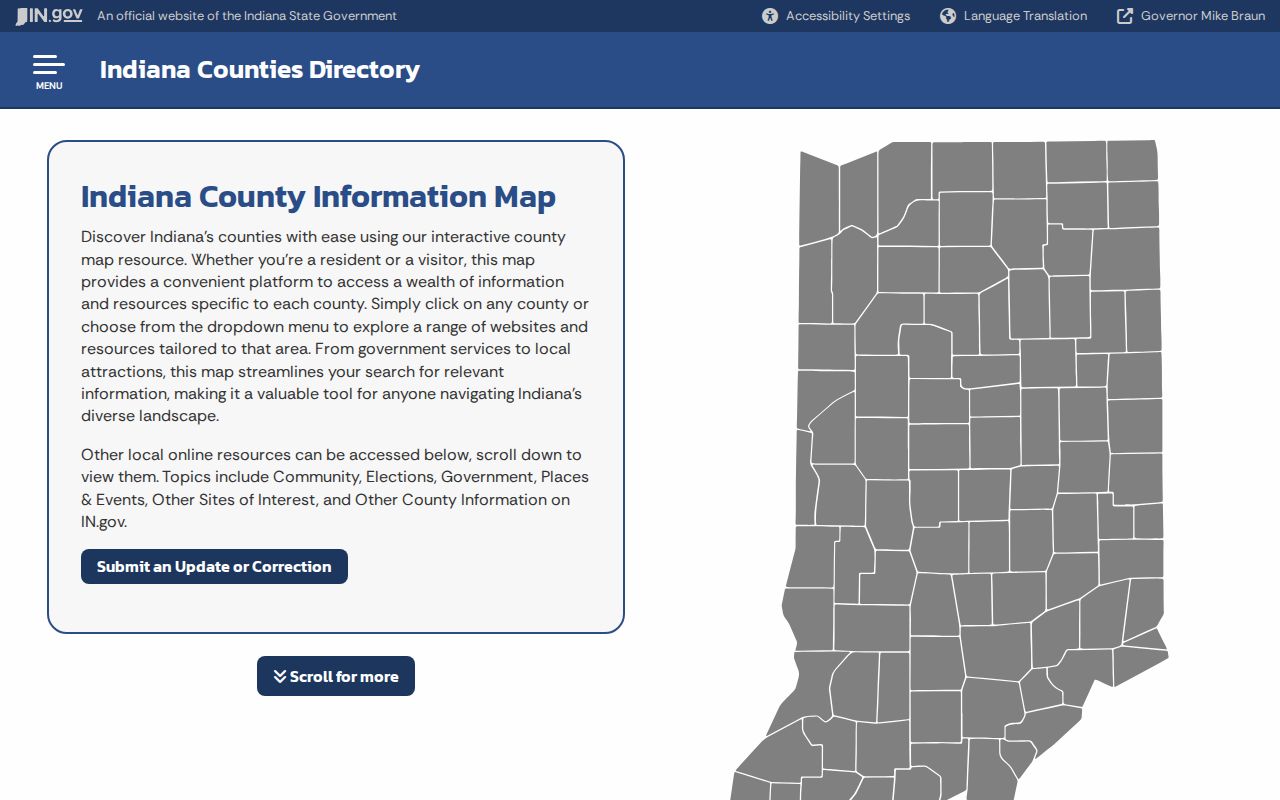
Use the full directory of all 92 Indiana counties to open the local hub for a different county. A county seat is a useful starting point. It does not determine which court issued a particular warrant.