
Indiana Active Warrants Explained
Indiana posts no public list of every active arrest warrant. The Judicial Branch says so plainly. No public website searches all arrest warrants. MyCase offers no warrant search either. A warrant can show up as an event in an eligible public criminal case, though. That docket line is not a statewide index. Nor does it certify current service status. The court's warrant FAQ draws the line in one sentence: Indiana has no public all-warrant search. "Active" and "outstanding" remain local labels in Indiana, not one statewide field. The words usually mean the court's process has not been carried out or recalled in the record kept by the issuing court or the serving agency. Those offices hold the official docket and the operational status. One sheriff's wording can differ from the next county's. No label replaces a current confirmation from the responsible office.
Indiana Has No Public Warrant List
No Indiana portal merges every county's active arrest warrants into one list. So no statewide search form offers a warrant-number field. None carries an agency or county filter, a refresh date, or an active/cleared result status. Those fields simply are not there to describe. The statewide law-enforcement systems serve authorized criminal-justice users only. An individual cannot log in for a public warrant check. This matters most when a search comes back empty. The court may not be represented in the online service. The Indiana record may fall outside the portal's date range. The case may carry a public-access restriction. An Indiana county may simply prefer a phone call or a visit. Indiana's real statewide answer is a routing task: find the issuing court, then ask the sheriff or other agency that holds the warrant record.
How Indiana Tracks Active Warrants
Indiana splits the warrant record path between courts and law enforcement. The judge logs the warrant action in the case. The sheriff or another assigned agency receives the process. That office serves the paper and tracks its own operational details. When a warrant qualifies for entry into the Indiana Data and Communications System (IDACS) and the national NCIC wanted-person file, only authorized criminal-justice users may query it. Those systems answer law-enforcement queries. They are not public county selectors. They are not self-service warrant databases. The Indiana State Police help run statewide law-enforcement communications and publish policies for the warrants their officers handle. That role does not make ISP the issuing court. ISP does not keep every county case either. A court order, a sheriff's service record, and an authorized index entry answer different questions. A court can recall a warrant before the agency finishes processing the change, so an Indiana docket update and a live agency confirmation may not land at the same moment.
Note: Indiana has no public statewide warrant feed or report cadence; a missing result on MyCase or one county page cannot establish that no warrant remains open.
MyCase Is Not an Indiana Warrant Search
MyCase can help you find an eligible public Indiana case and read its summary, court, and docket events. A warrant issued, served, or recalled entry points you toward the right court to call. It is a lead, not a warrant certificate. It cannot show that every Indiana warrant is indexed. Nor does it promise every document is online or that events match a sheriff's current status. Coverage also varies with court participation, filing date, case type, and confidentiality rules.
| Indiana Source | What It Can Show | What It Cannot Confirm |
|---|---|---|
| MyCase | Eligible public cases and docket events | A complete list or live service status |
| Issuing court or clerk | Official docket, orders, and case procedure | Another agency’s live service system |
| Sheriff or holding agency | Its local service status and instructions | All counties or every statewide index entry |
Open the official MyCase search tips. Treat a docket entry as a lead toward confirming any Indiana warrant. A result is not a certificate. An empty result does not close the question.
Inside an Active Warrant Record
Indiana publishes no statewide active-warrant result schema. No public search page lists its columns. The table separates what a case record may hold from what needs confirmation at the local level. It is not describing a state search that exists. A written arrest warrant has statutory elements, while MyCase and county pages expose only part of the underlying record.
| Warrant number | No public statewide format or search field is documented. |
|---|---|
| Person and offense | The written order identifies the person by name or certain description and states the offense. |
| Issuing court and county | The court case identifies the issuing court; the order states the county and issue date. |
| Bond or bail | The order specifies bail if any. Ask the court or sheriff for the current amount and accepted form. |
| Service status | Confirm active, served, recalled, or returned status with the court and responsible agency. |
| Case event | A MyCase event may show a step in an eligible case, not a live statewide status. |
A written Indiana arrest warrant has required contents. See IC 35-33-2-2 for them; the statute describes the legal document, not the columns of any public search page.
Note: MyCase docket events may lag an agency’s service record; confirm both the court’s order and the holding agency’s current status.
Indiana County Warrant Lists May Lag
Indiana county warrant lists vary. Availability and update notices differ too. The DeKalb County Sheriff's warrant page warns that its linked list may not be complete or current. That notice is a reason to call the local office, not a basis for treating the linked service as a statewide record or a substitute for the disclaimer the sheriff publishes. The sheriff's own page remains the official entry point.
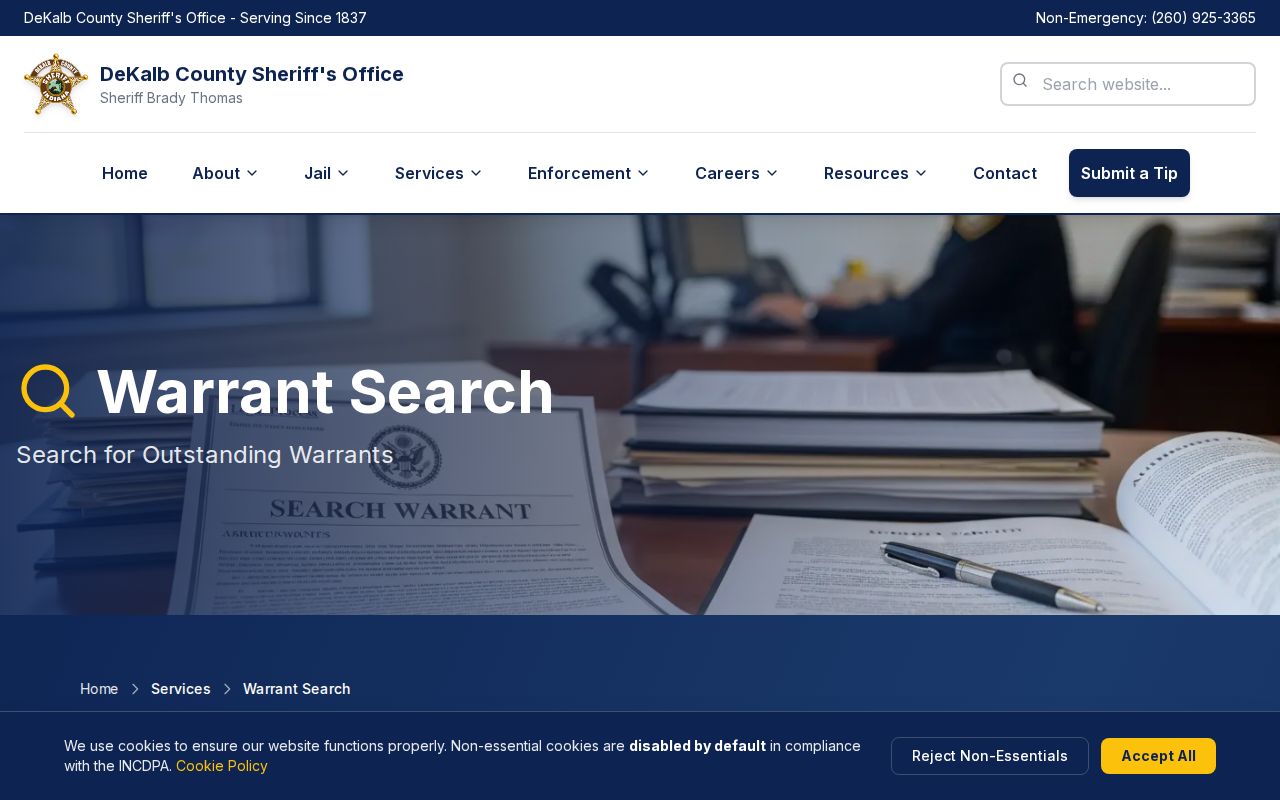
Indiana counties handle warrant lists their own way. DeKalb's sheriff sends visitors to a separate outside list. The sheriff also warns that it may be incomplete or out of date. Lake County takes a different approach: its official Warrant Search page covers both criminal and civil warrants from Lake County proceedings and is updated regularly. Even there, the county notes, technical transfers of data can delay what appears. An agreement screen comes up first, before any Indiana warrant search starts.
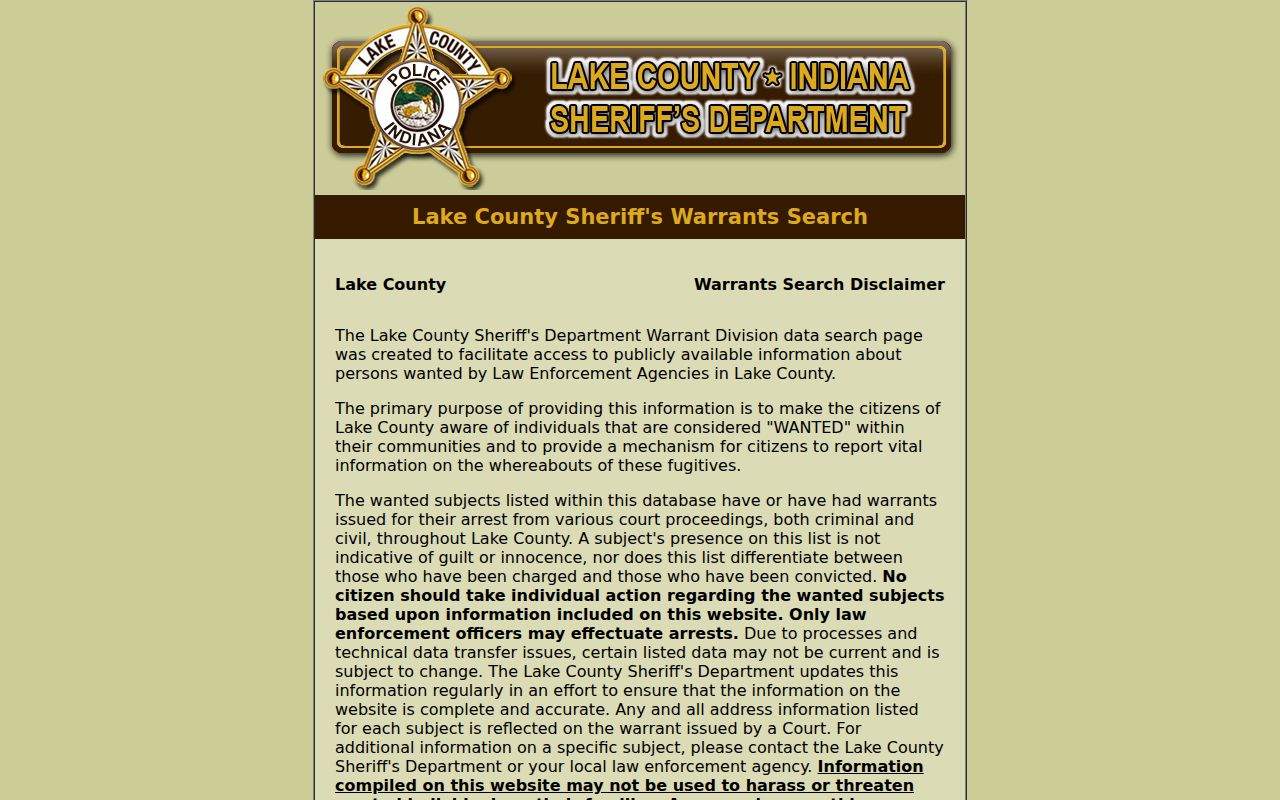
The Lake County screen points anyone with specific questions to its Warrant Division. It states no fixed update interval or public field schema. The Allen County Sheriff's warrant page is one more Indiana example. It gives office contact and voluntary-surrender instructions.
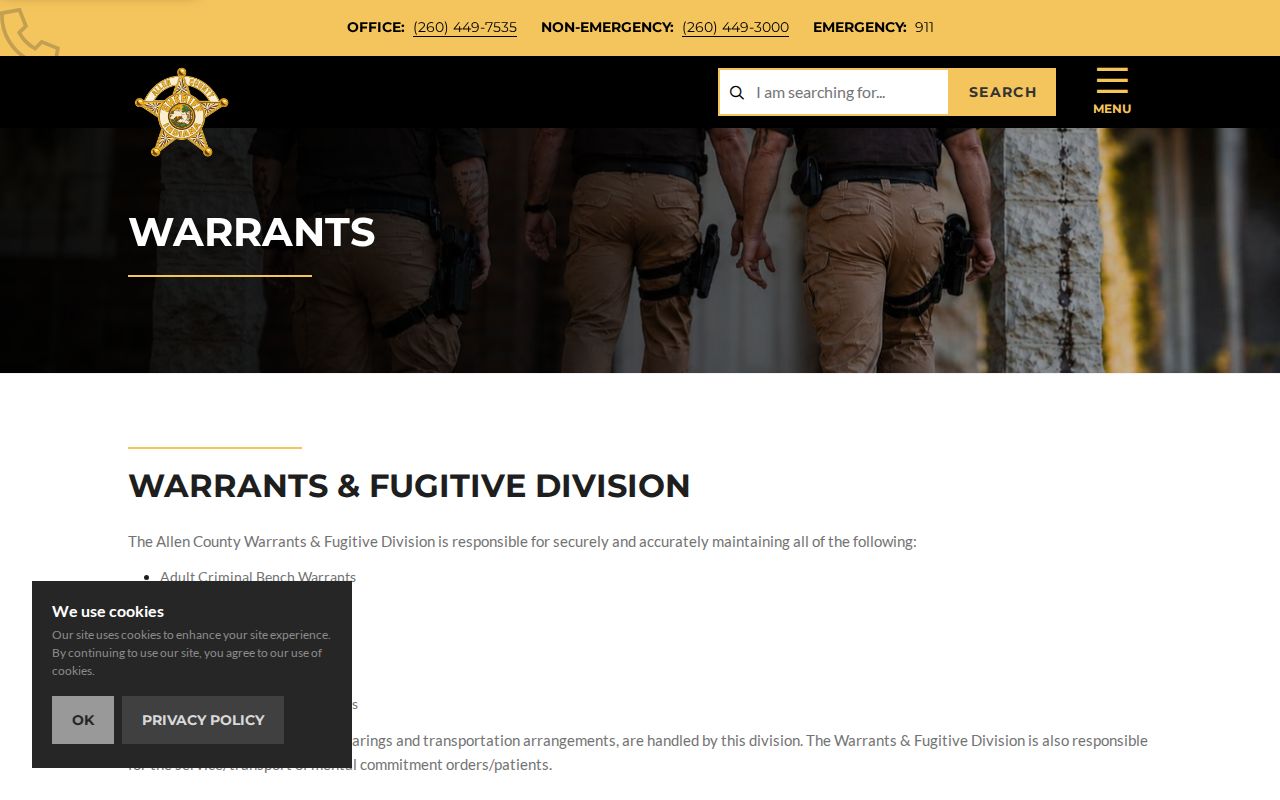
Allen County's route describes that county alone. Indiana sets no statewide rule from one sheriff's process. Hamilton County works differently. Its official Records page points to phone confirmation rather than a public warrant list.

Four counties, four approaches. Scopes, caveats, delay risks, and contact routes differ across Indiana, and no county list covers the whole state.
Warrant Roundups and Most-Wanted Lists
No statewide warrant roundup or amnesty list exists in Indiana. Some agencies keep narrower public programs instead. The Indiana Department of Correction's Operations Division links its "Fugitives: Most Wanted" program for people sought in connection with IDOC operations. That is a corrections fugitive program. It is not a roster of every outstanding court warrant in Indiana. County sheriffs may publish local lists or steer callers to a records line.
Key Point: Indiana’s official IDOC Operations Division page is the entry point for its fugitive program. Read its scope as corrections-specific, not as a complete county warrant lookup.
Do not rely on a curated wanted list to establish whether an unrelated county court has an open warrant.
Indiana IDOC Fugitives Are Not Warrant Lists
A fugitive program serves one agency's purpose and picks names to match it. IDOC's page tracks fugitives tied to the Department of Correction. It is not a court docket. It is not a list of every active warrant. Indiana State Police offers no public all-warrant search either. A federal fugitive task force adds another enforcement layer, not a public statewide index. The gap cuts both ways when you check your own name. A person can hold an outstanding Indiana county court warrant and never appear in a corrections or federal fugitive program. The reverse holds too. A spot in one program says nothing about every court event, bond condition, or local service instruction. Program questions go to the program's official contact. For a state-court warrant in Indiana, go to the issuing court and the county agency that serves it.
Note: No statewide tip line or reward program exists; use only the contact instructions posted by the official agency handling the case.
When Your Name Is on the Warrant List
First, verify the match. Confirm the entry is current and refers to the right person and the right court. Start with the sheriff or holding agency. Ask whether the warrant still shows active, which court issued it, whether bond is set, and what surrender or appearance process applies. Then speak with the issuing court or its Clerk of the Circuit Court about the docket, any recall order, and the next required step. Indiana has no single statewide warrant-resolution office. There is no universal walk-in rule, surrender location, bond amount, recall form, or fee anywhere in the state. A lawyer can advise whether a motion to recall or quash fits, whether to arrange an appearance, and what may happen at surrender. The clerk explains filing steps but cannot pick a legal strategy. Use the Indiana county directory to reach the relevant county layer. For a city or town case in Indiana, start with the court named on the citation.
Important: Before traveling to surrender, confirm the warrant and local procedure with counsel, the issuing court, and the service agency; an encounter can result in arrest.
Note: Indiana has no uniform bond schedule; the court order and holding agency control the current bond amount and payment route.
Why an Indiana Warrant Case Is Hidden
A case missing online may sit under an access rule. Indiana Rule 5 lets a court temporarily exclude an entire criminal case when an arrest-warrant request is filed at the same time. Probable cause changes that. Once it is established, the case generally becomes accessible unless the judge finds a rule-based risk. The exclusion order ends upon arrest. Rule 5 also treats certain supervision-violation matters separately. Investigation-only search-warrant cases can stay outside ordinary public access. On the agency side, the Indiana Access to Public Records Act, IC 5-14-3, covers agency records, though law-enforcement investigatory records may be withheld under its terms. Court dockets and documents follow the Indiana Rules on Access to Court Records instead. Direct each public request to the office that keeps the record. That means the Indiana court clerk for case materials. It means the sheriff for its own operational records, or another agency for records it holds. The current Indiana Rule 5 text spells out the timing rules. The state's APRA chapter covers the agency side. One caution applies. A record request is not a live status check, and it is not a motion to recall. If online access is limited, ask the clerk how an eligible person may inspect or request a public document. If the real question is whether the warrant can be served now, ask the responsible agency directly.