
Indiana Traffic Warrants Explained
A traffic warrant is a court order attached to one specific case. Indiana does not treat every late ticket the same way. Missed dates and unpaid judgments get the same individual treatment. One case ends in an arrest warrant. Another produces a civil judgment or a driving-privilege suspension instead. BMV notices and court warrants are different records. They can even trace back to the same citation. Traffic matters in Indiana begin in a county Circuit or Superior Court or in a local city or town court with authority over the matter, and the state has no justice-of-the-peace tier. Your citation names the court that received the case. That court's clerk can locate the docket and explain the right filing or hearing route. Because Indiana offers no public all-county arrest-warrant search, checking an Indiana traffic warrant comes down to the issuing court, plus the responsible law-enforcement agency for live service status.
Indiana Traffic FTA Warrant Rules
One statute does most of the work here. Indiana Code 9-30-3-8 covers failure to appear in specified traffic cases. For an Indiana resident facing a misdemeanor or felony traffic matter, missing court can bring an arrest warrant. The clock keeps running after that. If the warrant sits unexecuted for 30 days, the statute directs the court to send its copy to the Bureau of Motor Vehicles with an FTA notation and to mark the court record. Nonresidents get separate treatment under the same law. That is a court process, not a public statewide warrant lookup. Other traffic outcomes involve no arrest warrant at all. A civil infraction may never draw one. Failure to pay after judgment can instead hit driving privileges through a separate BMV report. So ask two questions. Does the court case carry an arrest warrant? Does BMV show a suspension? Read the current Indiana Title 9 reference alongside the case record. Then ask the issuing clerk which procedure fits the specific charge.
Key distinction: An FTA notation, an unpaid balance, and an arrest-warrant order are related possibilities, not interchangeable Indiana record statuses.
Indiana FTA and License-Hold Systems
Indiana runs a court-to-BMV notice path for traffic cases, not an OmniBase-style public warrant-hold portal. BMV spells out the triggers. Failure to appear after an officer citation, or failure to pay after judgment, may lead to a driving-privilege suspension. The court's record still answers the warrant question. That record is where you confirm whether an arrest warrant was ordered. BMV's Official Driver Record can name the court tied to an FTA suspension. It is a driver-status record, though. It is not a warrant search, and the two Indiana systems answer different questions. The table separates what each office can verify.
| Record or Channel | What It Can Show | Responsible Office |
|---|---|---|
| Court docket | Case events, court orders, and any public warrant event | Issuing court and clerk |
| BMV record | Driving-privilege suspension and reinstatement status | Indiana Bureau of Motor Vehicles |
| Warrant service status | Whether the serving agency’s record shows the warrant as active | County sheriff or other agency named by the court |
The BMV common traffic violations page lays out Indiana suspension consequences and points drivers back to the court. It offers no public warrant search by driver-license number.
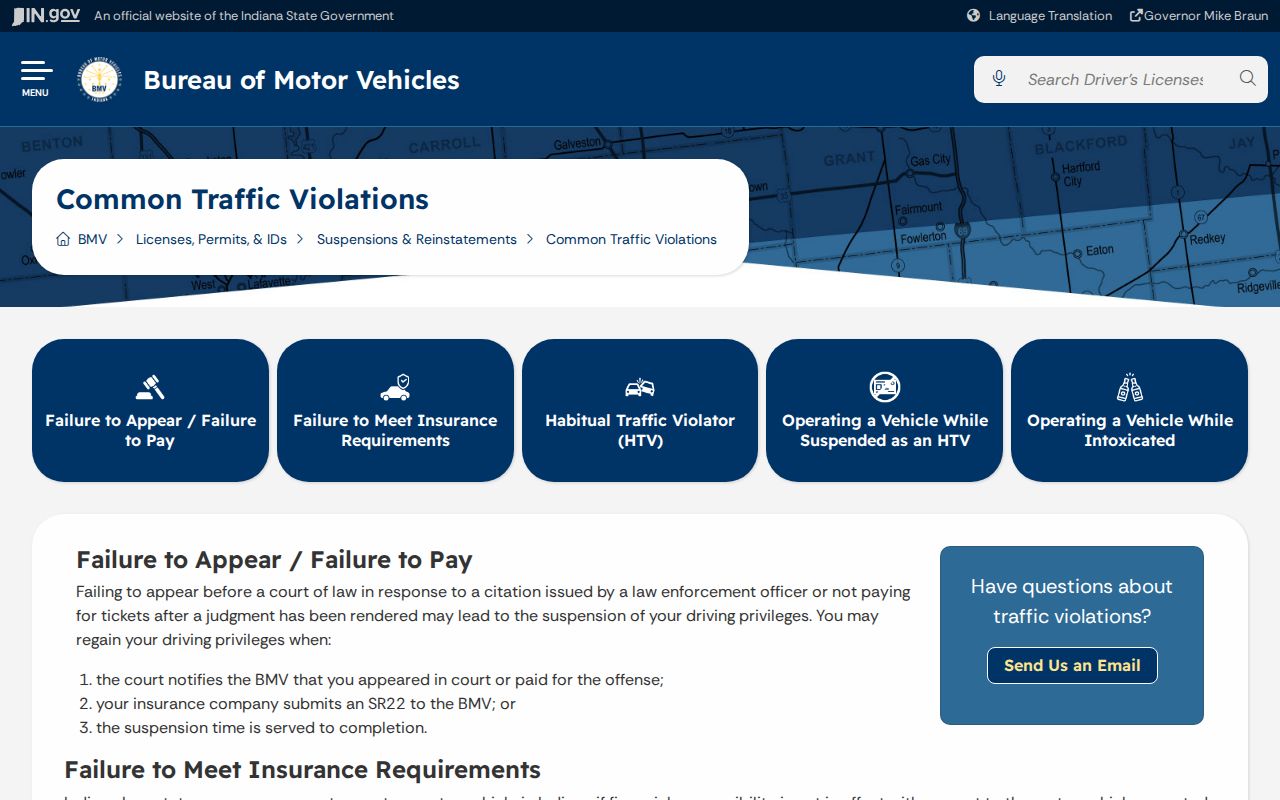
Indiana BMV guidance explains the administrative side of a traffic case. It cannot replace the issuing court's confirmation.
Indiana Has No Public Traffic Warrant-Hold Portal
MyCase is a case-search tool, says Indiana's Judicial Branch. Its public FAQ states plainly that no public website searches all arrest warrants across the state. BMV's traffic pages are no better for this; they explain license consequences and reinstatement but never run a statewide warrant query on a driver-license number. So a clean BMV record proves nothing about court warrants. A missing suspension cannot be read as proof that no Indiana warrant exists. For case context, MyCase works if you have the citation or case number and the court participates. Then confirm the docket with the clerk. Ask which agency handles service. A case that never appears may sit outside Odyssey, outside the online date range, or behind public-access rules. A no-result screen means nothing matched that search. It is not official clearance. The state's warrant-search FAQ points to the same local route: the issuing court controls the case order, and the responsible sheriff or other agency can confirm its service record.
Checking for an Indiana Traffic Warrant
Start with the paperwork. A citation number, court name, and filing date help the right Indiana clerk find the case fast. MyCase accepts citation numbers, but formats vary. Enter the number exactly as printed, and call the court if nothing comes up. The portal finds public case information. Current confirmation still comes from the issuing court and the service agency.
- Search MyCase by citation or case number, choosing the court shown on the citation when the search offers that option.
- Use the court name and case number from the citation or docket. If the matter is in a city or town court, contact that court’s clerk directly.
- Open the relevant county through the Indiana county directory to locate the county court and sheriff channels when the matter is held at that level.
- Ask the clerk whether a warrant order appears, whether a later order changed it, and which agency received the process. Ask the agency to confirm its current service status and bond instructions.
- If the record is unclear or an arrest order may be active, consider speaking with an attorney before deciding how to appear or respond.
Indiana Traffic Court Reminders Do Not Confirm a Warrant
Indiana courts can text you a hearing reminder, but a text is not a warrant check. The Indiana Judicial Branch runs an Odyssey reminder program for eligible cases, and only in courts that opted in. Reminders go out five days before a hearing and again one day before. That schedule holds when the court, case, and contact details all meet the program's conditions. Not every court participates. The roster on the reminder page is dated May 2021, so treat it as a sample rather than a current statewide directory. A reminder is a convenience. It is not a summons, and it does not replace reading a court notice or confirming the docket. The Judiciary sends case questions back to the local court. If you missed a date in an Indiana traffic case, call the court listed on the citation or notice and ask whether the judge issued a warrant and what steps the court requires. The official Odyssey reminder page lays out the eligibility rules and how to opt out; it offers preventive notice, not a promise of a message for every traffic matter. On the license side, the BMV's reinstatement instructions tell drivers to contact the court first and explain how court documentation gets processed.
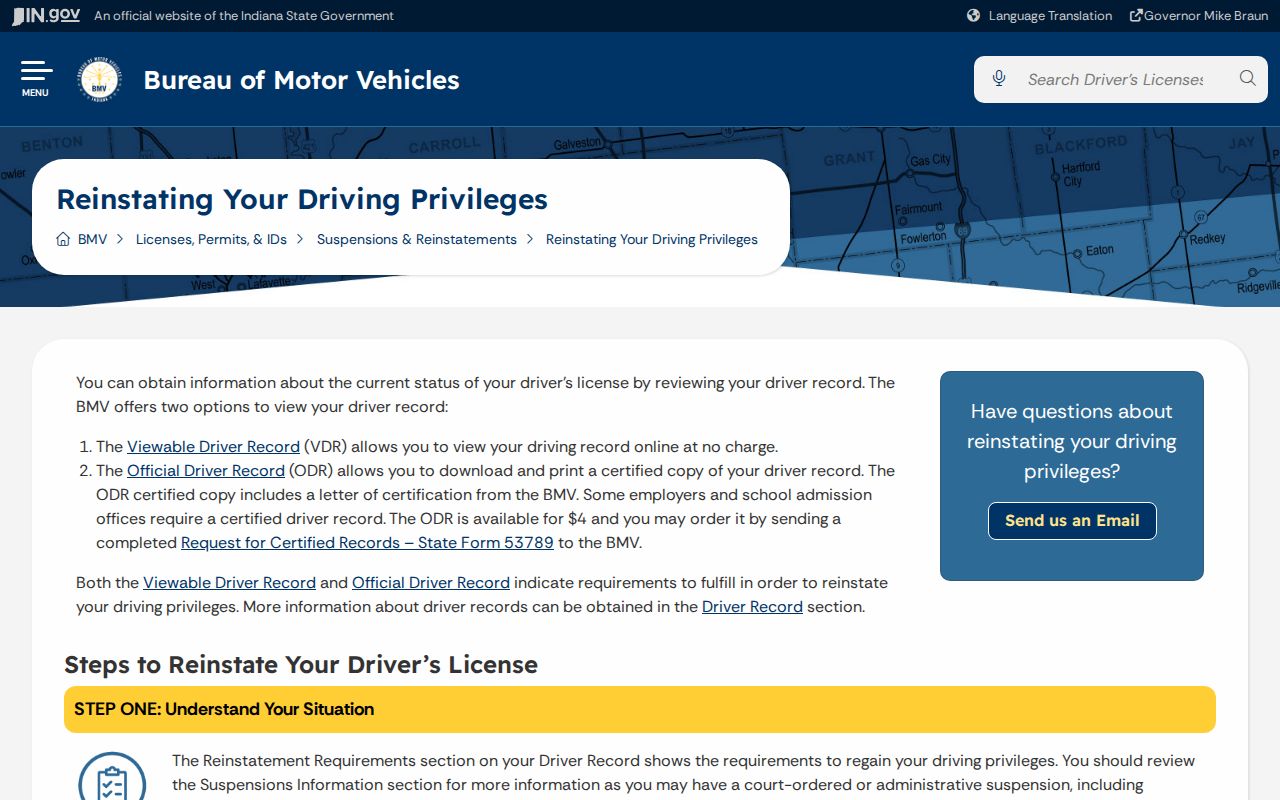
The Indiana BMV puts the court first: the court's disposition has to be settled before a driver-status record can be fixed.
How to Lift an Indiana Traffic Warrant
Indiana has no single statewide portal for paying or recalling a traffic warrant. Start by sorting out what you actually face. It may be an arrest warrant, an unpaid judgment, a BMV suspension, or a mix of these. Paying online may settle an amount the court allows that way. Payment alone does not recall a separate warrant. Only the judge or court can enter the action that changes the warrant, and then the clerk or agency must update its own record.
- Call the court on the citation or driver record and ask whether a warrant is active, what the case status is, and which office received the warrant.
- Ask the clerk about the court-approved option for the case, such as a hearing, payment where authorized, or a request for judicial relief. Availability depends on the court and case.
- Ask whether the court has entered a recall or other order and whether it has sent the required notice to BMV.
- Confirm separately with the sheriff or service agency that its warrant status reflects the court’s action, then check BMV for any remaining suspension.
Caution: Paying a ticket or restoring driving privileges does not by itself prove that a separate court warrant was recalled or removed from the serving agency’s record.
BMV says complete court documentation can take up to 10 business days to process for reinstatement. Fees depend on the driver record and the case. Indiana sets no uniform statewide "FTA warrant fee." Ask the court and BMV which amount, if any, applies instead of trusting a general estimate.
Indiana Child-Support Holds Are Not Traffic Warrants
Indiana’s Title IV-D child-support program can lead to an administrative or judicial license suspension. That process is separate from a traffic failure-to-appear case and does not establish that an arrest warrant exists. The Department of Child Services policy index includes a driver-suspension policy, while BMV directs a person with a child-support court-order suspension to the Child Support Bureau. The distinction matters when the driver record shows a hold unrelated to a traffic citation.
For a child-support suspension, the BMV Suspension Guide lists the Child Support Bureau at 317-234-6239 or 317-234-5700. It says BMV processing can take up to 14 days after documentation arrives. Ask the Bureau about the order or enforcement matter and verify the driving-status update with BMV; do not treat either contact as a traffic warrant desk.
The BMV suspension guide explains this separate route. The related DCS policy index describes administrative policy, not an arrest-warrant list.
The screenshot comes from the Indiana Child Support Bureau policy index, which provides the source context for this separate license-suspension pathway.
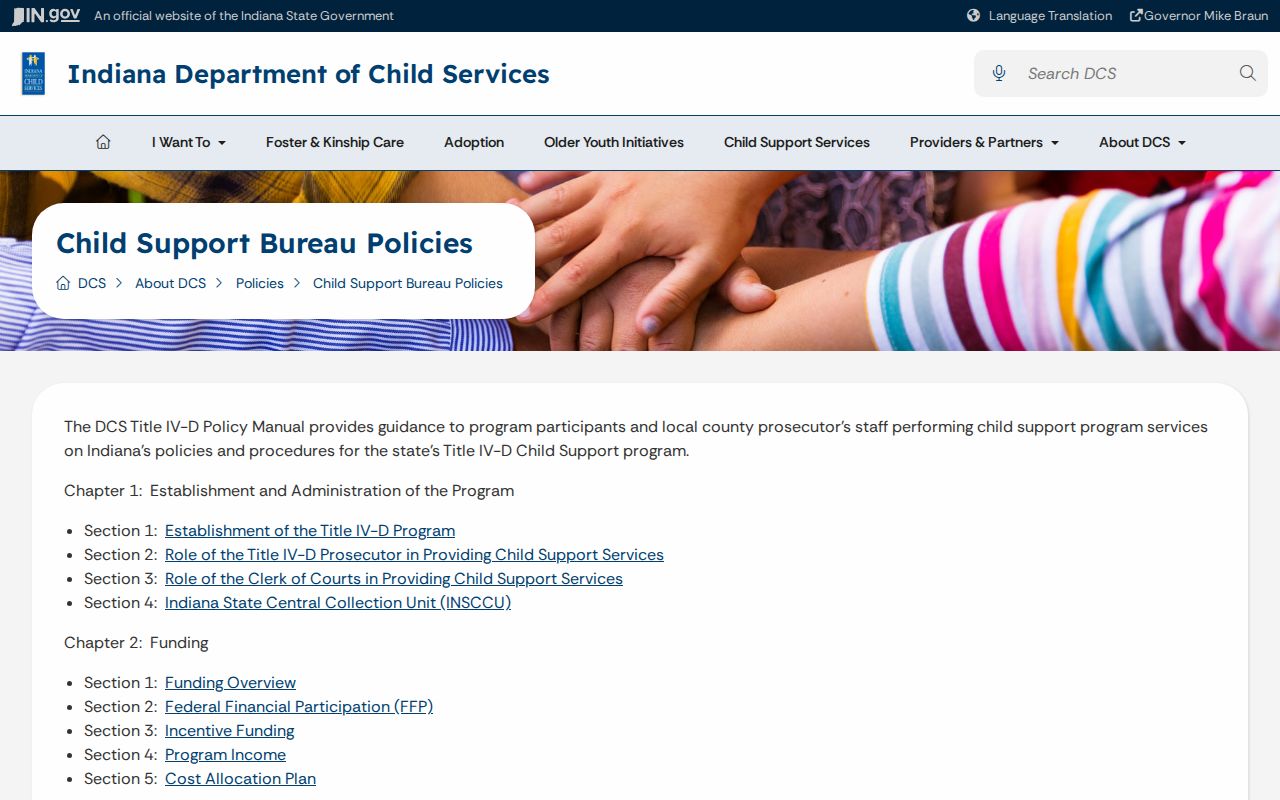
The policy index covers agency guidance only. It cannot show whether a traffic warrant exists in an Indiana court case. For the separate child-support suspension path, the BMV suspension guide is the source.
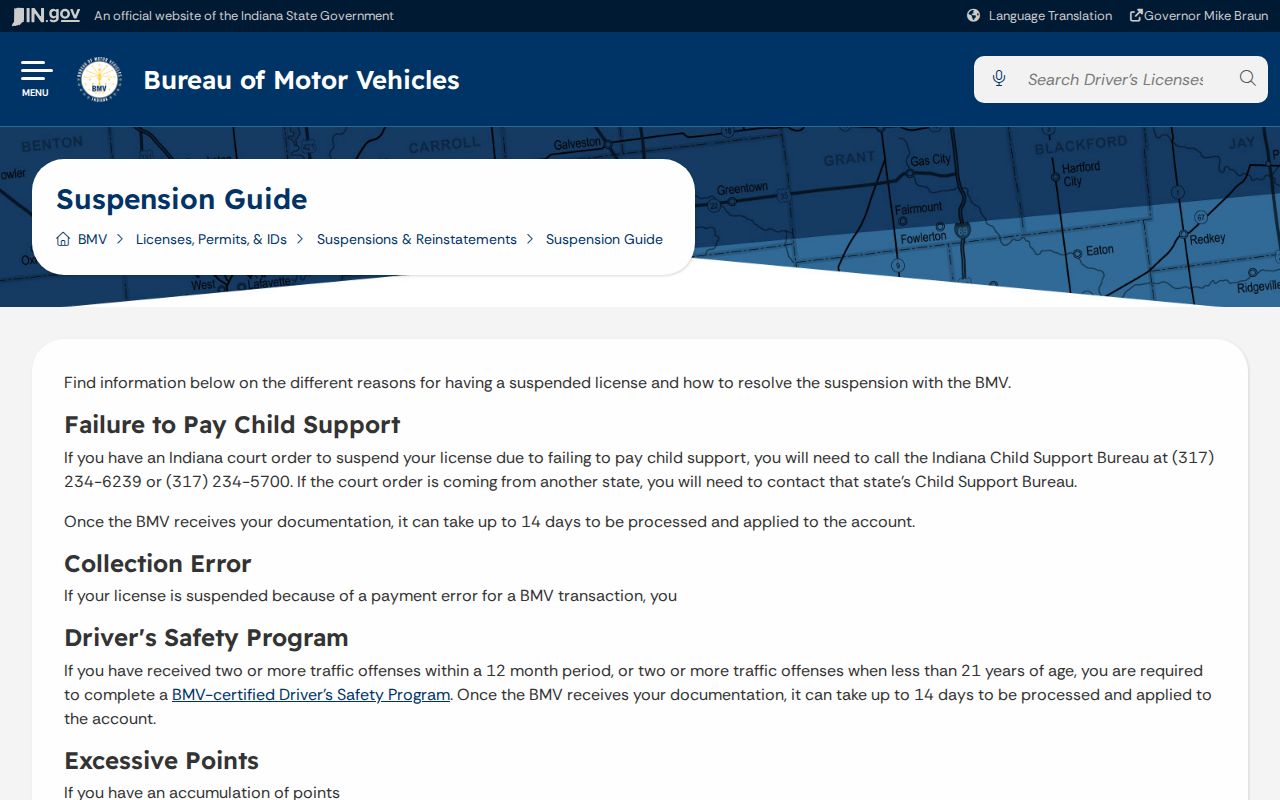
This Indiana guidance covers license consequences in a child-support matter, not the status of a court arrest warrant.
After an Indiana Traffic Warrant Recall, Check Both Records
Closing an Indiana traffic case rarely ends with one update. The court records the disposition or warrant order. The agency responsible for service keeps its own operational status. BMV updates the driving-privilege record once it receives what it needs. These systems answer different questions and may not change at the same moment. Keep the case number and any written order. Ask the clerk when the docket should show the court's action and whether notice went to BMV. Ask the sheriff or other holding agency whether it received the recall. Then review the official BMV driver record or fee flow if a suspension remains. If the court says an Indiana warrant was recalled but an agency record still shows it open, ask which office needs the order or confirmation. A payment receipt alone documents none of those steps.
Resolution sequence: court disposition, service-agency confirmation, and BMV status are separate checkpoints in an Indiana traffic matter.
How a Traffic Warrant Differs From a Driver Record
An Indiana traffic warrant is court process. A driver record is BMV's account of driving privileges and related notices. Neither one substitutes for the other. A BMV suspension may show that a court reported an FTA or some other event. It does not tell you whether an arrest warrant was issued, recalled, served, or reissued. And the absence of a suspension settles nothing about an Indiana court docket.
| Feature | Traffic Warrant | Driver Record |
|---|---|---|
| What It Is | A court order in a specific case | A driving-privilege and report record |
| Custodian | Issuing court; service agency confirms its own status | Indiana Bureau of Motor Vehicles |
| What It Confirms | Only the court and agency can confirm current warrant status | Suspension or reinstatement information |
| How It Changes | Court order plus agency record update | Court documentation and BMV processing |
| Where to Start | Issuing court via the county directory | Official BMV driver-record and reinstatement service |
One citation can link both records, but the legal and administrative steps stay separate. Indiana warrant lookup information explains the limits of MyCase and why you confirm with local officials.