
Inside the Indiana Warrant System
Indiana warrants grow out of a court case, not a state list. Circuit and Superior Courts handle trial matters for each county, and city or town courts can issue process within their own authority. The clerk keeps the record. The county sheriff, or another authorized agency, gets the process and serves it. Indiana State Police enforces state law and runs IDACS functions, but it is not a public warrant-clearing office you can call for your name.
The word "statewide" changes meaning depending on which system you mean. MyCase offers public case information from participating courts. IDACS and NCIC answer only restricted criminal-justice queries, and Indiana has no public website that searches every arrest warrant. For one case, confirm the docket with the issuing court and ask the responsible agency about live service status. The county directory leads from this hub to each county's sheriff and court contacts.
Indiana MyCase Is Not a Warrant Search
The Indiana Judicial Branch says it plainly. MyCase is not a warrant search, and no public website searches all arrest warrants statewide. When a case is represented and accessible, MyCase can show a public warrant event in the docket. That event is not a complete, current status index. There is no warrant-number field, no county dropdown built for warrants, and no active-versus-cleared filter.
Coverage varies too, because courts participate on different terms and older records, access rules, and document limits all play a part. A docket can carry an old event while missing a newer status update. So use MyCase to find the court and docket context, then ask the clerk about the official record and the sheriff or originating agency about service. An empty search is not a clearance. The Judicial Branch warrant FAQ, the MyCase overview, and the Odyssey court list spell out these boundaries. For a route through public court and sheriff channels, see Indiana warrant lookup.
Indiana Statewide Warrant Databases
Indiana runs a restricted information layer for law enforcement, not an open arrest-warrant database. IDACS is the state's criminal-justice communications and information system. NCIC is the FBI's national index for authorized agencies. MyCase sits apart as the public court-case layer. Each serves different users and purposes, so a public case search can never query IDACS or tell you what an officer would see. The table below separates systems and records that are easy to confuse; only MyCase is public, and even MyCase is not a warrant search.
| System | Scope | Access and Administrator |
|---|---|---|
| MyCase / Odyssey | Public case summaries and eligible docket events from participating courts | Public case portal; Indiana Judicial Branch court technology |
| IDACS | Criminal-justice communications and authorized record queries, including warrant information handled by agencies | Restricted to authorized users; Indiana State Police IDACS Administration Unit |
| NCIC | National criminal-justice index that may carry warrant entries | Restricted agency access; Federal Bureau of Investigation |
| BMV | Driving-privilege records and specified court-reported events | Indiana Bureau of Motor Vehicles; not a warrant database |
| INcite e-Tax | Subscriber access to civil tax-warrant information in 79 counties | Judicial Branch application; tax records only |
The official IDACS overview describes a criminal-justice communications system with no public name search. Indiana's case portal and its law-enforcement databases answer to different users. The official page lays out the system context without person-level warrant data.
Use this Indiana state-system reference to understand the restricted network, not to check an individual warrant.
Indiana ISP’s Role in Warrant Information
Indiana State Police is a law-enforcement agency, not a court or clerk. Its Communications and Information Systems page places IDACS Administration inside the Criminal Justice Information Services Section and the Criminal Justice Data Division. That unit handles system administration and support. It does not run a public, case-by-case warrant-status desk, so your actual status has to come from the county or agency that holds the record. ISP policy materials cover internal warrant service and validation work. One published 2018 standard operating procedure says ISP districts validate active warrants every 30 days and sets a timing rule for ISP-maintained misdemeanor-warrant entries. That procedure governs ISP's own practice. It does not create a 30-day feed from every Indiana county, prove that all local warrants enter IDACS or NCIC, or make any warrant expire on its own. The ISP Communications and Information Systems page identifies the administration unit, and its agency contact details cannot replace the originating sheriff's case-specific confirmation; the page shows where IDACS administration sits within state police information services.
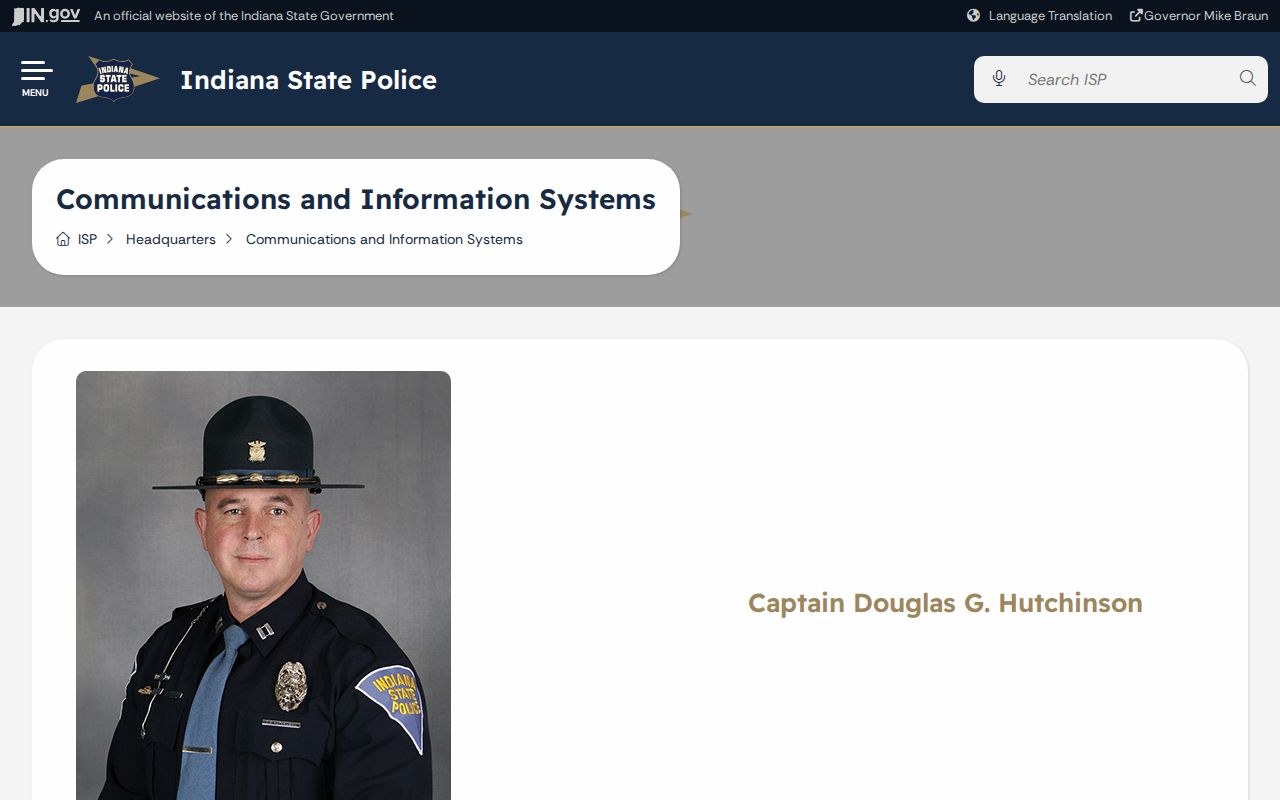
The image backs up the agency-role distinction for Indiana State Police; it shows no public warrant search and no person-level result.
How Indiana County Warrants Reach the State
A county warrant starts inside a court case. The clerk keeps the official record, and the sheriff or another authorized agency receives process for service. When an agency enters a warrant into IDACS or NCIC, that originating agency stays responsible for accuracy, validation, and confirmation. The public never sees the restricted entry through a general web search.
Warrant flow: Indiana issuing court and clerk › sheriff or authorized agency › IDACS / NCIC where entered
Indiana keeps no public master list of county warrants. No county-participation table exists either. And nothing guarantees that every one of the 92 counties transfers its warrants into IDACS or NCIC nightly or in real time. A municipal, bench, probation, or traffic warrant may never reach those systems at all. Some Indiana courts never show up in MyCase, and a case can be temporarily excluded. A county sheriff list may cover only a subset. A blank result at one layer clears nothing statewide. For local records, start with the county directory; the issuing court confirms its order, and the sheriff or other holding agency confirms whether service is still active.
Indiana Has No Statewide Warrant Amnesty
Indiana has no statewide warrant amnesty. No all-county warrant day or voluntary-surrender event exists at the state level. A single Indiana county or court may announce a local, temporary resolution event, but there is no common eligibility rule or statewide participation list. Confirm the date, warrant type, court, and terms with the official local office before relying on an announcement.
Labels can mislead, too. An 'amnesty' tag does not dismiss an Indiana case. It waives no fee and removes no IDACS/NCIC entry on its own, and a judge's order plus an update from the holding agency may still be required. A traffic payment can leave a separate warrant open. So can a BMV reinstatement. Indiana's Odyssey text-message reminders are preventive notices for opted-in eligible courts, not a warrant resolution program.
Start with the issuing court. Ask the sheriff or service agency to confirm status and bond. Get legal advice where you can. Then use the court-approved appearance or motion process. After a judicial order, confirm that both the clerk and the agency records reflect it. Local Indiana contacts sit in the county directory, and the Judiciary's Odyssey reminder page describes a notice service, not amnesty or automatic recall.
Fugitive Warrants and the US Marshals
Indiana’s federal warrant layer sits apart from state-court process. The Northern District of Indiana and the Southern District of Indiana each keep a U.S. Marshals office for federal court warrants and fugitive work. Federal fugitive task forces may bring in state and local partners, but those operations are not a public Indiana warrant list. A county warrant stays with its issuing court and the responsible local agency even when partners help serve it. Indiana MyCase does not search federal dockets, and a federal district office cannot recall a county court’s order. For a federal matter, use federal court records and the right Marshals district contact, whose current routing details the Northern District and Southern District offices publish; a state or county matter still routes to the local court and sheriff. The federal Judiciary’s PACER service opens public district-court dockets and documents, subject to fees and sealed-record limits, and that docket context cannot replace confirmation with the relevant federal office or guarantee every warrant is visible.
The image shows the same federal docket-access route, not an Indiana county warrant search.
Indiana Rule 5 Can Temporarily Hide a Warrant Case
Indiana court records follow access rules, not just the online portal. Access Rule 5 is the one that matters here. It lets an Indiana judge temporarily exclude a qualifying criminal case from public view while an arrest-warrant request is pending. The rule builds in a transition once probable cause is established. The exclusion then ends upon arrest, subject to the rule's terms and any judicial ruling. Keep in mind what this rule actually does. It changes records access only. The warrant itself stays just as valid. The current Rule 5 version took effect July 1, 2026. That is why an Indiana public search can show a missing case or document for a legal reason. Never read warrant status into a blank result. An Indiana clerk can explain the proper public-record route. Ask the issuing court about its docket. Ask the agency responsible for service about its operational record. You can read the current Indiana Rules on Access to Court Records, Rule 5 yourself. The Indiana Access to Public Records Act (APRA), Ind. Code 5-14-3, governs records held by public agencies, while the court rules govern court-file access. Send each request to the office that keeps the record. The county Clerk of the Circuit Court holds a case docket or order. The sheriff holds its own operational records. The Office of Judicial Administration handles only the records it holds. The Indiana Judiciary's public-records request guide explains those paths. One caution applies. APRA is a records-access process, not a warrant-status hotline, and a request to one office never reaches another office's files.
Indiana Statewide System vs County List
Indiana keeps no single public warrant list. The statewide index, IDACS/NCIC, serves authorized agencies only; it helps them locate and confirm a wanted entry, but the public cannot query those systems. A county court holds the order and docket. The sheriff or originating agency is the operational source for service status. A local online list may be partial. Its update schedule can differ from county to county. No public all-warrant feed exists in Indiana, so completeness cannot be compared county by county.
| Feature | Statewide System | County Warrant List |
|---|---|---|
| Source | Authorized IDACS/NCIC entries and queries | Issuing court docket and agency record |
| Public Access | No public self-service search | Public record access depends on court rules and local publication |
| Coverage | No public county participation or completeness table | Specific case and agency scope; local list may be incomplete |
| Authoritative Status | Entry must be confirmed with originating agency | Court confirms its order; holding agency confirms service status |
| Update Timing | No public universal sync schedule | Ask the clerk and agency when their records reflect an order |
County matters go through the Indiana county directory first. Then confirm with the clerk or sheriff. For public case events, the MyCase guidance covers what that portal will and will not display.
Indiana e-Tax Searches Tax Warrants Only
Indiana does have one statewide searchable product, but it is not what most warrant searches need. The Judicial Branch sells INcite e-Tax, a paid subscription covering civil tax-warrant information. Arrest warrants, bench warrants, probation warrants, and traffic warrants are all outside it. According to the court's own page, clerk-held data covers 79 counties. That number describes this tax-record service only. Treat it as tax coverage, not arrest-warrant coverage. The subscription page lists three tiers: individual access, individual access with reporting, and business access, with annual prices for the e-Tax application alone, not for checking or clearing any criminal warrant.
| Subscription | Published Annual Fee | Scope |
|---|---|---|
| Individual | $600 | Tax-warrant search subscription |
| Individual with reporting | $1,200 | Tax-warrant search and reporting option |
| Business | $5,000 | Business tax-warrant subscription |
The Judicial Branch e-Tax page lays out the subscription choices for civil tax records. The Department of Revenue describes that civil collection exchange among the state, clerks, sheriffs, and collection agents. It is not an arrest-warrant channel.
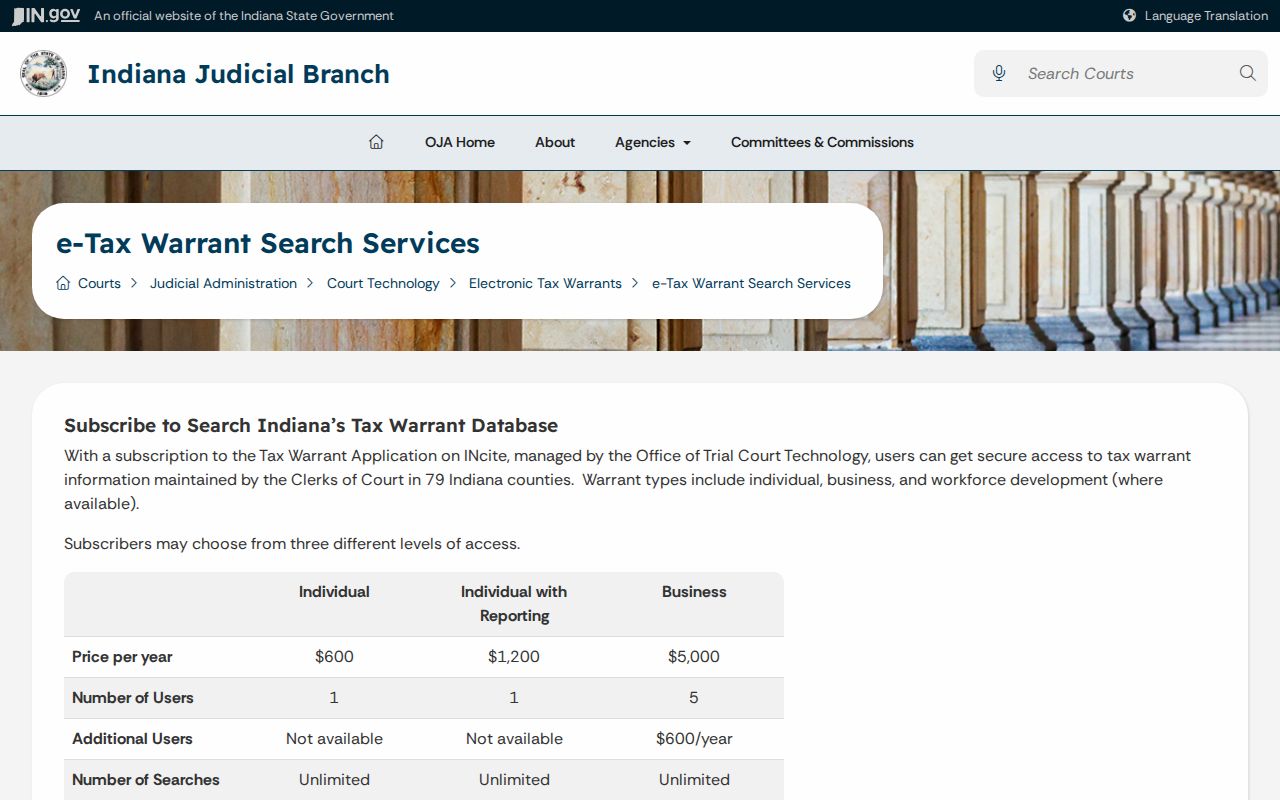
This image shows the tax-product pricing context, not a public criminal warrant query.
Indiana Warrant Technology and History
Indiana built its court technology around case management and separate agency workflows, not one public warrant database. Odyssey rolled out across county and local courts over time. MyCase then made eligible public case information searchable. Converted legacy cases can still carry older numbering or event labels. Online documents stay subject to court participation and access rules. IDACS handles communication and validation for authorized criminal-justice users. It sits apart from the public court portal entirely. Dated milestones show how these layers grew, yet none of them amounts to a complete statewide public list or a guaranteed feed from every court to every agency.
| Period | Milestone | Limit |
|---|---|---|
| 1981 framework | IC 35-33-2 sets arrest-warrant issuance, contents, service, and reissuance rules | Statutory process does not define a public search portal |
| 2000s onward | Odyssey was deployed to courts in phases | Check each court’s participation and coverage dates |
| 2018 | Judicial Branch hearing reminders and ISP validation guidance were documented | Reminders are opt-in; ISP procedure does not establish countywide sync |
| July 1, 2026 | Current Rule 5 version took effect | Access rules govern visibility, not warrant validity |
Indiana Court Districts Do Not Centralize Warrants
Indiana spans 92 counties, 26 judicial administrative districts, and more than 400 trial courts statewide, per the Judiciary's current court-technology description. Roughly 300 of those courts serve the counties. The wider count adds city, town, and other local jurisdictions. Districts support court operations. They create no separate public warrant jurisdiction and no central record office. That is why one county or city name on a citation matters more than any statewide administrative label. The issuing trial court holds the case. The county Clerk of the Circuit Court keeps the county court records. The sheriff or another authorized service agency confirms its own warrant status. For a city or town matter, use the court named in the paperwork and ask which agency received process. Indiana Administrative Rule 3 sets the district organization. For local contacts, the county directory is the right route.