
Indiana Bench Warrants Explained
A bench warrant is an order from a judge, usually issued after someone misses a required appearance or ignores a court direction. In Indiana, it is part of a specific case rather than a statewide search category of its own. Docket entries describe it in different ways. You might see "bench warrant," "FTA," "warrant ordered," or another event label entirely. The label is only shorthand. The order and the docket tell you the real basis, so a search result alone never explains the full picture. These warrants can arise in felony or misdemeanor matters, traffic cases, probation proceedings, city or town court cases, and some civil processes. Not all of them are minor. Not every missed payment becomes an arrest warrant either. Indiana uses no uniform statewide label of "capias pro fine" for traffic failure-to-appear process. Whether a missed date leads to a warrant, bail action, or another response depends on the case and the judge's order.
Note: “Bench warrant” does not name a separate statewide database; the local case docket and signed order define the trigger.
Indiana Admin Districts Are Not Warrant Desks
Indiana organizes its courts into 26 judicial administrative districts under Administrative Rule 3. Those districts exist for court administration. They do not create 26 separate warrant jurisdictions, a statewide warrant counter, or a public search portal. A bench warrant stays tied to the court handling the underlying case. The clerk, sheriff, or other service agency works at the county or local level. The state's trial-court structure centers on Circuit and Superior Courts, with arrangements and divisions varying by county. Each county's Clerk of the Circuit Court keeps trial-court records. Local city and town courts may have their own clerks. The Indiana court system overview helps sort out those court levels. An administrative district name alone will not tell you where a particular bench-warrant motion or hearing must go.
- FTA
- Failure to appear at a required court date; consequences depend on the case and order.
- Recall
- A court action withdrawing a warrant, which must be recorded and communicated to the service agency.
- Return
- The officer’s report to court about whether the process was served.
How Indiana Bench Warrants Are Issued
The judge handling the case decides whether a missed appearance or other failure calls for arrest process. A court has options. It may issue a bench warrant, order an appearance, change release conditions, or take another step allowed in that proceeding. Indiana has no one public statewide rule that grants a universal grace period, warning letter, or warrant fee for every case. The actual order and local procedure control. Once the warrant issues, the clerk records the court event and the sheriff or another designated agency receives process for service. An eligible MyCase case summary may show a docket entry. But no public statewide "bench warrant" flag gathers all counties. A county sheriff also cannot decide whether the judge should recall a warrant. If the court later changes its order, ask both the clerk and the agency to confirm the update reached their records.
Indiana Reminder Texts Do Not Recall Warrants
The Indiana Judicial Branch offers optional court-date text reminders for eligible cases in participating Odyssey courts. A person who opts in, with contact details on file, can get reminders five days and one day before a scheduled event. That message is only a prompt to attend. It is not a new summons, a promise that every court participates, or proof that a bench warrant was recalled. The official Odyssey reminder description sets out the participation and eligibility limits and directs people to contact the county court about a case.
A missed hearing still needs direct confirmation with the court listed on the notice. The text service answers nothing about warrant status in Indiana, whether or not a reminder arrived.
Note: Indiana court reminders are optional and eligibility-based; a text does not change a hearing date or withdraw a warrant.
Bench and Arrest Warrants Compared
"Bench" describes the court-process setting, while an arrest warrant is the broader written process directing an officer to bring a person before the issuing court. The labels overlap. A bench warrant is also an arrest order. The distinction still matters, because a missed appearance in an existing case has a different trigger from an arrest warrant issued on a criminal charging route. See the related Indiana arrest warrant search for the statutory warrant document and access rules.
| Feature | Bench Warrant | Arrest Warrant |
|---|---|---|
| Trigger | Missed appearance or another court-process event, as the order states | Charging route under statute, including an information or indictment |
| Who Issues It | The court handling the existing case | A judge or court under IC 35-33-2 |
| Underlying Case | Often an existing case with a required appearance or condition | A criminal case in which arrest process is ordered |
| How It Changes | The issuing judge orders recall or another court action | The issuing court changes or recalls the warrant |
Indiana City Court Warrants Need Local Clerks
Indiana's city and town courts have their own limited jurisdictions and may keep their own case records. A citation from a local court may not run through the county Circuit Court clerk. It may not appear in a sheriff's public list either. There is no statewide municipal-court warrant lookup. Use the court named on the paper. Then ask that court's clerk which agency receives its process. Noblesville City Court is one official local contact example. Its page is not a public warrant search. The example simply shows why the court name on a citation matters. It does not establish a statewide municipal procedure. Indiana has no justice-of-the-peace court tier, so do not use an older or out-of-state label to guess which Indiana court issued a warrant.
Note: Indiana has no JP tier; identify the local city or town court from the citation rather than from an older assumption.
Indiana Bench Warrant Checks Use Local Fallbacks
Indiana counties handle warrant checks their own way. When no online search exists, the Bartholomew County warrant FAQ tells visitors to come in person with photo identification. That instruction belongs to one county alone.
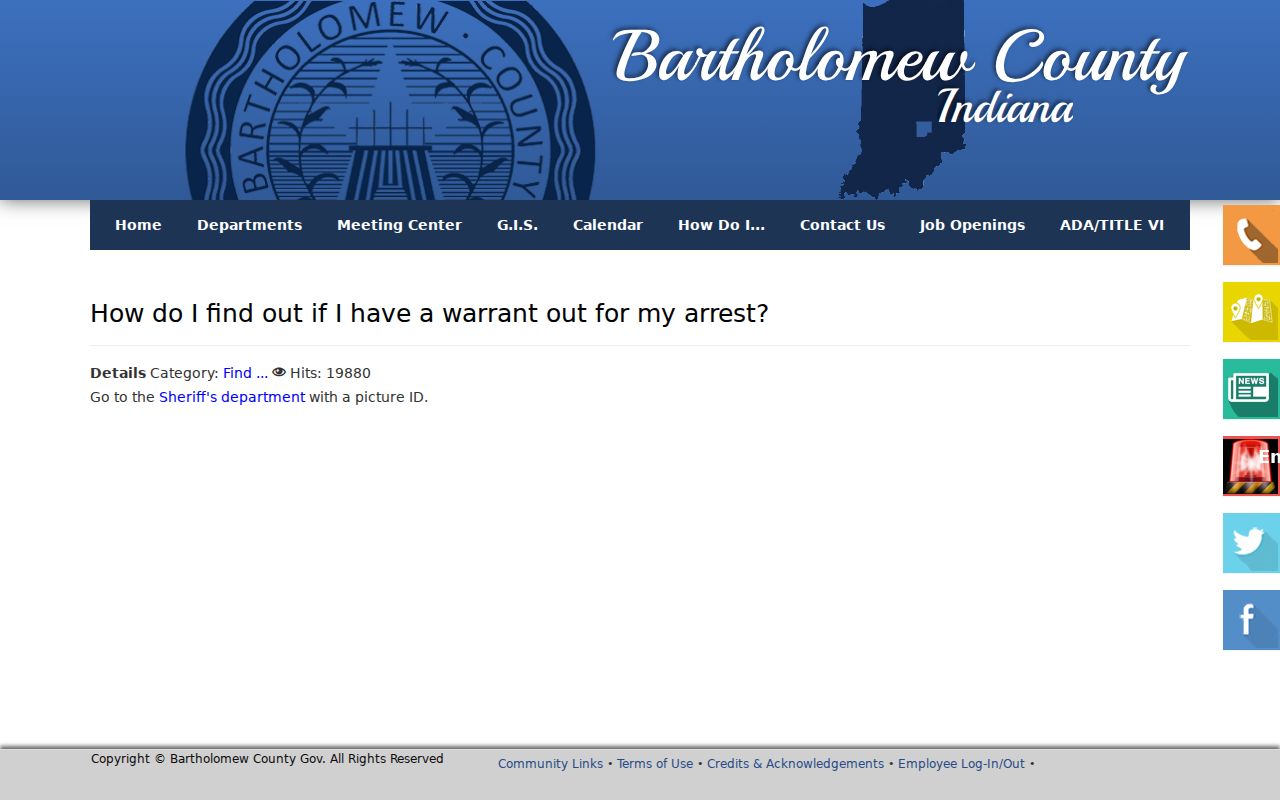
That photo-ID rule belongs to one county's published method. Indiana sets no statewide form for this. Wait times, fees, and what another county will accept can differ, so call ahead. Phone confirmation works elsewhere too: the Hamilton County Sheriff's Records page is a second Indiana example. Before you travel, pull the current sheriff or clerk contact page for the court you're dealing with. Ask what identification the office needs and how its request process works.
Resolving an Indiana Bench Warrant
Begin with the issuing court. Confirm the bench warrant is still active before anything else. Indiana has no statewide recall portal, standard walk-in docket, universal surrender address, or set fee. A judge controls the judicial order itself. The clerk can walk you through local filing and hearing steps, while the sheriff or service agency can confirm its own operational status. The practical sequence is this:
- Identify the court, case number, and missed obligation from the notice or case record.
- Ask the clerk whether an order issued, whether it was recalled or reissued, and how the court wants a request or appearance arranged.
- Ask the sheriff or other service agency about current status, bond terms, accepted payment method, location, and local surrender procedure.
- Speak with counsel about a motion to recall or quash, a new hearing date, bond, or voluntary surrender.
- After a court action, confirm that the docket and service agency have both recorded the change.
No statewide surrender location exists in Indiana. Recall procedures vary by court too. If the court has not issued a new appearance order, ask its clerk how an attorney or party may request the next court step.
Caution: Do not assume an old bench warrant expired. Indiana’s 180-day misdemeanor arrest-warrant rule is type-specific; confirm the document, return, and any reissue with the issuing court.
Note: A bench warrant can follow different rules from an arrest warrant; ask the issuing court before assuming an expiration date.
Indiana MyCase Events Are Not Bench Warrants
MyCase is a public case-search tool for participating Indiana courts. It is not a statewide bench-warrant status service. An eligible docket may still show a warrant-issued or recall event. But the system can omit cases because of court participation, filing-date coverage, case type, or public-access restrictions. A case summary helps you locate a court and case number. It does not prove an agency has updated its service record. Start with the exact court named on the citation or notice. If the event seems missing, call the clerk and ask whether the case can be found by its local number or citation. For current service status and bond instructions, go to the sheriff or other agency that received the process. If a judge recalls the warrant, ask when the order will appear on the docket and which agency will receive it. When a public court document is not online, ask the local clerk about the inspection or copy process. Indiana court records follow the Rules on Access to Court Records. A sheriff's operational records request falls under the Access to Public Records Act. The right office may require its own form or fee. And a records request still does not establish real-time warrant status.
Finding the Court That Issued It
Read the court name and case or citation number on whatever you have: the notice, the summons, or the MyCase summary. The issuing court controls whether to recall or change an outstanding warrant. The sheriff serves process and can tell you what its system shows, but cannot grant judicial relief. For county felony and misdemeanor cases, ask the Clerk of the Circuit Court to route you to the right Circuit or Superior Court division. A public docket may show an event even when the warrant document itself is not available online. Ordinance, traffic, and other local matters run differently. Use the city or town court named on the citation and contact its clerk. Don't assume every local warrant sits with a county Circuit Court, or that all city-court cases appear in one sheriff list. The Indiana county directory routes to each county's local information. When a city court issued the process, contact that court directly and ask which agency received it.
Note: A public-record request can locate an eligible case document, but current service status must still come from the agency holding the warrant.